Author: Ms. Farzaneh Golkar
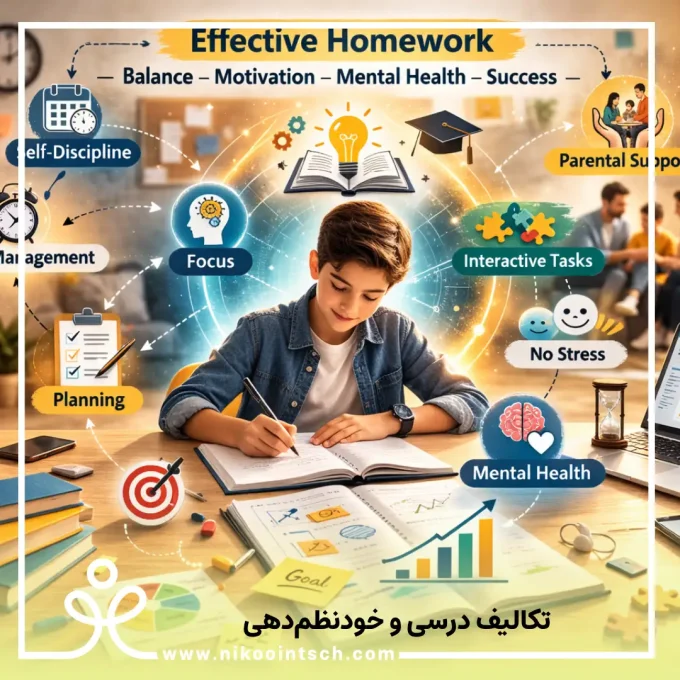
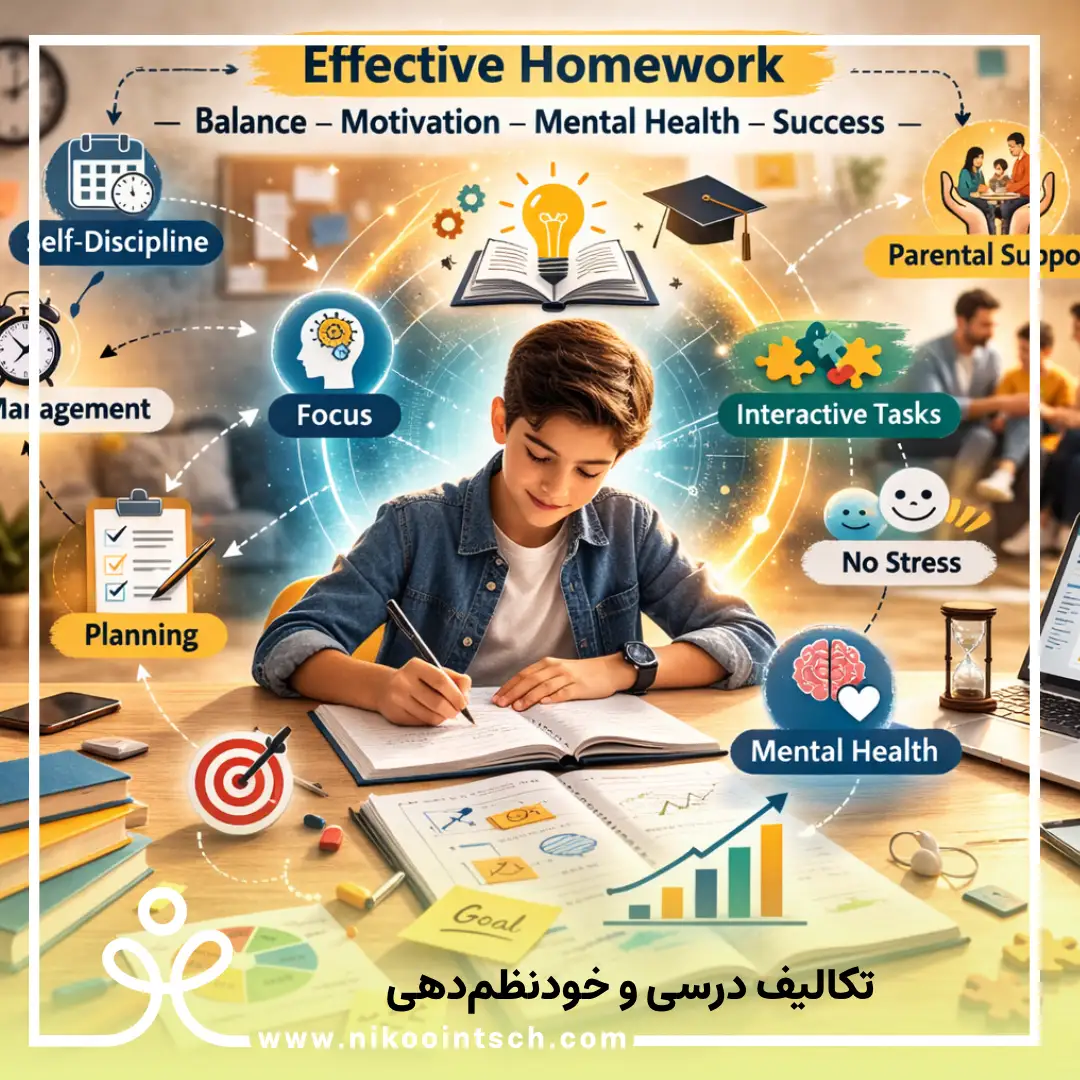
In recent years, homework has been reexamined not only from the perspective of academic achievement, but also in relation to mental well-being, executive functioning, and academic motivation. Recent research shows that the quality of students’ homework experience is more important than its quantity.
At Nikoo International School, the counseling approach is based on the latest scientific evidence and emphasizes self-regulation, autonomy, and emotional balance in the homework process. Recent studies indicate that homework management is one of the strongest predictors of academic success.
This concept includes the following components:
- Time management
- Distraction management
- Study environment organization
- Progress monitoring
- Learning consolidation
Research by Núñez et al. (2019) also showed that students who use self-regulation strategies in completing homework experience more sustainable motivation and lower levels of anxiety.
The relationship between homework and academic achievement:
Recent meta-analyses, including Fan et al. (2017) and subsequent updates, have shown that:
- The relationship between homework and academic achievement in elementary school is moderate to weak.
- The quality of homework design and the level of cognitive engagement are more important than the amount of time spent.
- Interactive and problem-based homework has greater effectiveness.
Recent OECD reports (2020, 2023) also indicate that countries with very high homework loads do not necessarily achieve higher academic performance; rather, balance between learning and psychological well-being plays a decisive role.
Homework and student mental health: Recent research has raised concerns about homework-related pressure. Studies by Maltese et al. (2018) and more recent reviews (Pascoe et al., 2020) show that:
- Excessive homework volume is associated with increased stress and academic burnout.
- Parental pressure can intensify performance anxiety.
- Students’ perception of external control significantly reduces motivation.
The Role of Parents:
Recent findings in the field of math anxiety (Maloney et al., 2019) show that parental anxiety, when transferred during homework assistance, can negatively affect children’s performance.
Structured autonomy support research indicates that the most effective parental support includes:
- Providing limited choices
- Asking guiding questions instead of giving direct answers
- Focusing on effort and learning process
- Providing structure without excessive control
Studies from 2022–۲۰۲۳ also emphasize that excessive supervision is associated with reduced sense of competence and increased academic procrastination.
Executive functions and homework in the digital age: Recent research shows that digital distraction is one of the most significant challenges in completing homework.
Weak cognitive inhibition and poor attention regulation are associated with procrastination and lower homework quality. Therefore, it is recommended that:
- The study environment should be free from mobile phones.
- Homework should be divided into 20–۳۰ minute intervals.
- Attention regulation techniques such as active breaks should be used.
Recommendations and Strategies
- Homework quantity alone is not an indicator of academic success.
- Self-regulation and homework management are key predictors of academic performance.
- Parental support should be structured but not controlling. Balance between academic progress and mental well-being is essential. Therefore, homework policies should be designed based on optimal challenge, cognitive purposefulness, and support for student autonomy.