
Analyzing the Decline in Student Motivation in the New Generation
In recent years, many schools have faced a common phenomenon: students who appear bored, show less participation, and sometimes seem indifferent toward their studies and future. At first glance, this situation may be attributed to a lack of effort or weak discipline; however, deeper analysis reveals that motivation decline is a complex and deeply rooted issue.
To address this challenge effectively, it is essential to move beyond observable behaviors and examine the psychological, social, and educational factors underlying it.
۱. Changes in Attention Patterns in the Digital Age
Today’s generation is growing up in an environment where information moves at an extremely fast pace. Social media, short videos, and fast-paced content have reshaped attention span and patience. In such conditions, if teaching methods remain based on one-way, long-form content delivery, it is natural for students to lose interest.
This boredom is not necessarily a sign of personal weakness; rather, it may indicate a mismatch between teaching methods and the learning style of the new generation.
۲. The Need for Meaning in Learning
One of the most important drivers of motivation is the effectiveness and meaningfulness of learning. According to Self-Determination Theory, developed by Edward Deci and Richard Ryan, people are most motivated when they feel that what they are doing is voluntary, valuable, and connected to their personal goals.
If students cannot see the connection between what they learn and their future lives, their intrinsic motivation gradually decreases and is replaced by indifference.
۳. Psychological and Social Pressures
The new generation faces multiple pressures:
- Concerns about future career opportunities
- Constant comparison on social media
- High expectations from families
- Rapid social changes
- Information overload and rapid knowledge growth
- Reduced sense of security
In such an environment, indifference can sometimes act as a defense mechanism—a way to cope with excessive pressure.
۴. Feeling Overlooked
Students who feel that their voices are not heard or their abilities are not recognized may gradually disengage. Motivation develops when individuals feel valued and seen.
Healthy human relationships in the classroom play a critical role in maintaining motivation. A simple and respectful conversation can have a deeper impact than disciplinary warnings.
۵. Generational Gaps in Expectations
Sometimes teachers and parents evaluate today’s students using standards from previous generations, even though values, communication styles, and definitions of success have evolved. If not properly managed, this gap can lead to misunderstandings and decreased motivation.
Solutions to Address This Challenge
▪ Redesigning the Learning Experience
Using project-based, research-based, discussion-based, and collaborative methods can increase student engagement.
▪ Strengthening Dialogue Instead of Giving Orders
Listening to students’ concerns is the first step in rebuilding motivation.
▪ Supporting Personal Goal Setting
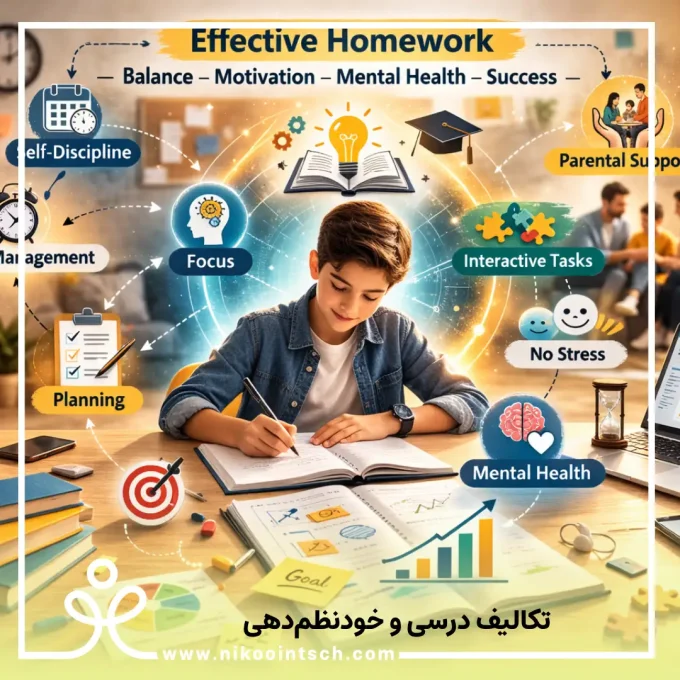
Students who define their own goals take greater responsibility for their learning.
▪ Paying Attention to Mental Well-Being
Academic and emotional counseling can help prevent boredom from turning into chronic disengagement.
Nikoo School’s Approach: Joyful Learning in an International Environment
At Nikoo School, we believe that meaningful learning happens only when students enter the classroom with motivation, a sense of belonging, and a positive mindset. Therefore, our focus is on creating a safe, respectful, and inspiring environment where students can:
- Feel safe and valued
- See themselves as part of a multicultural community
- Engage in learning with enthusiasm and active participation
- Develop planning and goal-setting skills
Nikoo School’s approach is not based on pressure or enforcement. Instead, it encourages students to develop an internal belief in the value of learning, participation, and responsibility. When intrinsic motivation develops, active engagement and high-quality personal growth occur naturally. As a result, learning becomes a meaningful, enjoyable, and effective experience in a vibrant and supportive environment.
Conclusion
Boredom and indifference in the new generation should not simply be attributed to laziness or weak discipline. This phenomenon is the result of a complex interaction between social changes, technological influences, psychological pressures, and developmental needs.
Successful schools focus on creating meaning, connection, and intrinsic motivation rather than relying on pressure or labeling. When students feel seen, heard, and understand the purpose of learning, their journey naturally shifts from disengagement to active participation.